
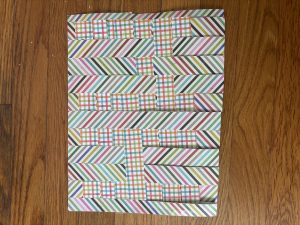
For our assignment, I created a paper weaving design that spelled out my initials, HW. At first glance, it was just strips of paper going over and under each other, but the process felt like a clear metaphor for the transition from analog to digital systems.
The weaving itself represents analog: it is physical, tactile, and continuous. Each strip overlaps another in a pattern that builds up gradually, with no clear “on” or “off” boundaries. The final product—the letters H and W—emerges from these overlaps, similar to how analog signals flow in waves rather than discrete points.
At the same time, the sharp edges of the woven letters resemble the logic of digital. The H and W stand out as recognizable symbols, like binary code producing readable information from simple ones and zeros. What begins as flexible strips of paper becomes structured and ordered, just as digital computing organizes data into precise forms.
This assignment reminded me that the digital revolution did not appear out of nowhere—it was woven from analog foundations. The weaving of my initials became more than a craft project; it was a small-scale illustration of how human creativity and tradition continue to intersect with the logic of technology.